
To: OFEW Review Committee; Mary Ann Smart; Mark Stacey
Fr: Berkeley Initiative for Freedom of Inquiry (BIFI) Executive Council
Re: BIFI Members’ Perspectives on Enhancing OFEW’s Alignment with Berkeley’s Mission
Da: May 4, 2026
Executive Summary
How should the Office for Faculty Equity and Welfare (OFEW) orient its work relative to Berkeley’s core academic mission?
The University’s governing documents define our mission clearly: Berkeley exists to concentrate exceptional faculty and students in the pursuit of knowledge at the highest level, educating leaders for the state and the world. The California Master Plan for Higher Education assigns Berkeley a distinctive role within the UC system precisely because not all campuses serve the same purpose. OFEW’s administrative functions play a decisive role in determining whether Berkeley’s practices remain faithful to that mission.
The findings in this report draw on a structured survey of BIFI members (N=12), supplemented by commentary from BIFI members who read this memo, and by analysis of OFEW’s published guidance, rubrics, and search materials. BIFI members identify four structural concerns and specific recommendations for each:
- Mission alignment: Some OFEW guidance frames research and teaching excellence as secondary to procedural and social goals, inverting the relationship between means and ends.
- Explicitly embrace excellence in research and teaching as the primary goal of candidate searches
- Apply cost-benefit analysis to procedural requirements, evaluating fairness benefits against the imposition on faculty time
- Empower all searches to use of letters of recommendation
- Limit OFEW’s ability to intervene in searches that follow an approved plan
- Viewpoint neutrality: Certain evaluative rubrics and job advertisement language condition candidacy on adherence to contested normative positions, raising concerns under Regents Bylaw 40.3.
- Evaluative rubrics should be developed by the senate and be viewpoint neutral
- Ensure that search policies originate with faculty input and is grounded in legal authority
- Replace staff-confected, values-alignment declarations with Berkeley’s Principles of Community
- Legal framework and authority: OFEW’s compliance framework omits the University’s most fundamental prohibition on political tests in faculty appointments; several requirements appear to exceed what governing law actually mandates; and OFEW has, in some members’ experience, characterized its advisory role as more authoritative than it is. As such, OFEW’s practices undermine shared governance.
- Incorporate Regents Bylaw 40.3 into all OFEW guidance materials
- Have the senate retain neutral outside counsel to evaluate which OFEW requirements are legally imposed versus confected
- Have OFEW communicate search-related decisions to the full search committee, rather than through individualized consultation with chairs
- Conflict of interest policies: The Senate should replace OFEW’s conflict of interest guidelines with rules tempered by faculty experience in managing conflicts that may have discipline-specific components.
- Replace the current OFEW COI policy with one developed by the Senate, such as the existing R\&E COI policy
- Incorporate time limitations and discipline-specific contours to enable flexibility and discretion
- Incorporate less costly cures to conflicts, such as disclosure and recusal
We present two reform paths. The first integrates OFEW’s core compliance functions into existing faculty governance structures. The second retains OFEW as a distinct office but substantially reorients its mission from procedural oversight to genuine faculty welfare. Both share a common premise: that administrative structures should reinforce, rather than redirect, faculty professional judgment.
We offer this report in the spirit of constructive engagement, and welcome dialogue with the faculty review committee on the evidence and recommendations that follow.
Findings
1. Commitment to Excellence and Mission Alignment
OFEW defines equity as ensuring that individuals have access to opportunities and resources, “resulting in reduced disparities in achievement, representation, and advancement.” The aspiration toward fairness in this definition is widely shared. However, as an operational standard for an R1 institution, it may orient administrative activity toward outcome equalization rather than opportunity enhancement, a distinction the California Master Plan treats as central to Berkeley’s differentiated role.
OFEW’s July 2025 search presentation advises committees to avoid “generic criteria” such as “excellence in research,” suggesting instead that committees evaluate “inclusive research practices that promote the excellence of research.” This framing, however well-intended, risks subordinating research distinction itself to a methodological condition rooted in identitarian ideology. Excellence is assessed in terms of rigor, originality, and contribution to knowledge. These are epistemic rather than demographic criteria.
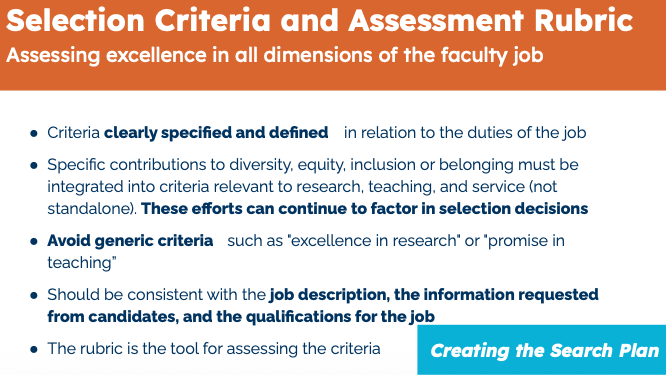
A related structural problem appears in OFEW’s search guide, which states that searches “must” be fair and equitable, while noting as an “also” and a “vested interest” that Berkeley seeks to hire faculty who will make extraordinary contributions in research, teaching, and service. This is an inversion of mission.
The practical consequences of this inversion have caused grave reputational harm to Berkeley. In the Life Sciences cluster search, DEI statements were reviewed and candidates eliminated, before research statements were read, resulting in applicants being screened out on non-scholarly grounds. Whatever the intent, the sequencing made explicit what the guidance implies: that ideological criteria were treated as threshold requirements, and scholarly merit as a secondary filter.
Guidance that frames our mission otherwise can shift institutional culture in ways that are difficult to reverse. Survey respondents identify this as a lived experience: one describes OFEW as engaged in “continued emphasis on DEI expressed in more subtle language,” while another characterizes the effect of current rubrics as de-legitimizing “the concept of merit.”
OFEW’s search oversight also introduces procedural requirements (staged reviews, structured interviewing, detailed documentation at multiple thresholds) with aggregate effect on faculty time that has not, to our knowledge, been evaluated against demonstrated benefits. This part of the letter presented data from the Faculty Bearometer and this data is not available to the general public, but UC Faculty Members can request it from the Bearometer’s question keepers. Survey respondents echo this: one describes OFEW as giving their department “a hard time at many stages of our searches, which frequently results in delays which jeopardize the success of our search.” Another notes that requiring representation at all steps of the selection process led to flying out candidates the committee already knew it would not hire, “an abuse of everyone’s time.”
OFEW’s conflict of interest guidelines illustrate this cost-benefit gap concretely. They lack a time limitation, do not account for the prevalence of multi-authored papers in the sciences, require excessive procedural steps (such as mandating non-comparative written evaluations from conflicted faculty), and create an unnecessarily adversarial process for gathering information. Survey respondents confirm the practical consequence: “COI measures for search committees have been hugely problematic for some of our recent searches, preventing the faculty most qualified from even being involved in the search or discussion of candidates.” To be clear, we fully recognize the necessity of COI policies, and explain below steps to cure the OFEW COI approach.
A BIFI member reports that in 2022 their unit was instructed, via a Dean, that letters of recommendation could not be used in their faculty search, over the objection of the search committee. The same member notes that some campus units obtained exemptions from this restriction. Another BIFI member reports that OFEW advised not to consider unsolicited emails from non-colleagues about potential candidates. This member also relates that OFEW has advised against considering whether a given candidate is “gettable,” meaning that faculty must spend cycles evaluating candidates that have no realistic intent of joining our campus.
Faculty already have strong professional incentives to evaluate candidates honestly; policies that assume bias as a default convey mistrust of that professionalism without demonstrable compensating benefit. Separately, survey respondents flag that restricting faculty access to letters of recommendation compounds this problem by limiting the information available to those faculty who do participate.
An office committed to faculty welfare should apply a cost-benefit lens to its own procedures, asking not only whether each requirement promotes fairness in principle, but whether its demonstrated benefits outweigh the time drawn from research and teaching.
2. Viewpoint Neutrality in Evaluation
Faculty hold diverse, principled views on how best to advance fairness in academic settings. Some emphasize formal equality (applying uniform standards to all candidates and students) as both the fairest and most legally defensible approach. Others favor substantive equity, which attends to differential outcomes and seeks to address them. Both positions have serious intellectual and practical advocates, and both are compatible with commitments to inclusion.
OFEW’s evaluative materials have not consistently maintained this distinction. Berkeley’s former DEI rubric assigned the lowest scores to candidates who expressed an intention to “treat everyone the same,” a formal equality approach. The OFEW rubric treated that mainstream position in political philosophy as evidence of inadequacy. The rubric’s highest scores were awarded to candidates who described themselves as “strong advocates” for diversity, equity, inclusion, and belonging, and who could document multiple advocacy activities. Whatever the intent, this framework conditions the outcome of a faculty search on a candidate’s normative commitments, sounding in a contested ideology.
One BIFI member reported an instance when OFEW objected to a shortlisted search candidate’s DEI statement, which endorsed the ideal of equal treatment for all. OFEW demanded that the department either remove the candidate from consideration or deviate from its approved search plan by requiring all candidates to give live DEI talks during their interview visits. The department reluctantly acceded to the second option, so that it would not have to eliminate the candidate.
Survey respondents identify what they characterize as a continuing pattern even after the 2024 rubric revision: “the recent effort to sidestep the elimination of the ‘diversity’ statement in hiring by inserting it into other areas of candidate evaluation” is described as “an obvious attempt to subvert the intent of the policy.” Another respondent identifies “attempts to introduce DEI principles, some in direct contravention of civil rights obligations that have already drawn scrutiny to the campus, into assessment of candidates’ excellence in teaching/research/service” as a deliberate circumvention of the ban on standalone DEI criteria. We cannot verify the intent behind these developments, but the structural pattern (evaluative criteria migrating from one form to another after regulatory constraint) warrants the committee’s attention.
OFEW’s 2024–2025 search guide also stated, “…Our excellence can only be fully realized by faculty…who share our commitment to these values. Successful candidates for our academic positions will demonstrate evidence of a commitment to advancing equity, inclusion, and belonging.” This statement is bizarre because it seems to be an empirical statement, but it defines success based on widely contested terms that themselves do not carry fixed meanings. Requiring their affirmation as a condition of candidacy goes well beyond Berkeley’s own Principles of Community, which affirm honesty, integrity, and respect.
We acknowledge that OFEW has revised its rubric since 2025. Our concern is that as scrutiny has been focused on these concepts, they are rearranged in the search process. OFEW should instead promote political neutrality, for reasons we explain below.
3. Legal Framework, Authority, and Shared Governance
OFEW’s July 2025 search guidance identifies the legal authorities that govern faculty recruitment: the California Fair Employment and Housing Act, UC Regents Policy 4400, California Code Section 11103, and APM 210-1-d. However, it omits the most direct prohibition on ideological conditions in faculty appointments: Regents Bylaw 40.3, which provides that “no political test shall ever be considered in the appointment and promotion of any faculty member or employee.”
This provision is as binding as any other rule governing searches. Its absence from OFEW’s compliance framework, accompanied by attempts to introduce political concepts into searches, suggests a blindness to the responsibility to be politically neutral.
A related concern involves the legal basis for specific OFEW requirements more generally. Structured interviewing, repeated staff review of shortlist determinations, and the 21-step framework recently introduced for non-Senate searches are not, to our reading, mandated by FEHA, Regents Policy 4400, or APM 210-1-d. They appear to reflect OFEW’s interpretation of those authorities. Survey respondents raise this with specificity: one asks of OFEW’s approval role over long lists, short lists, and target-of-opportunity hires: “where do they derive authority for these?” Another describes OFEW as having “no such authority” to approve candidate lists. We suggest that the Senate hire neutral outside counsel to evaluate what is really a requirement.
Survey respondents also describe OFEW as, at times, misrepresenting its own authority by characterizing its advisory role in pre-search workshops in ways that overstate its power to compel. One respondent describes OFEW as having “imposed constraints on units on campus by implicitly promising retribution—delay in approvals—if units did not comply with practices that are not rules.” The same respondent welcomes the recent clarification (the email from Professor Smart) that OFEW is advisory-only except where actual rules are being violated, and notes this as “very helpful.” The committee may wish to assess whether that clarification has been consistently communicated.
Two accounts are particularly specific and, if accurate, warrant direct attention. This part of the letter presented data from the Faculty Bearometer and this data is not available to the general public, but UC Faculty Members can request it from the Bearometer’s question keepers.
We cannot independently verify these accounts, but they are consistent with the structural pattern identified above: OFEW acting beyond an advisory role in ways that may lack legal grounds.
OFEW’s conflict of interest policy compounds these governance concerns. We support COI policies and recognize that California law grants institutions substantial discretion in defining and managing faculty conflicts; with the exception of direct financial interest or nepotism, campuses may design policies that preserve integrity without broadly restricting professional judgment. OFEW’s current framework is considerably more restrictive than the Senate-approved Rules Committee policy and does not appear to reflect that discretion proportionately. A Senate-led revision establishing clear temporal limits, distinguishing unlawful conflicts from ordinary professional interaction, and emphasizing disclosure over exclusion as the default mechanism would better align the policy with both law and academic norms.
Finally, OFEW’s practice of advising search chairs through individualized consultations creates information asymmetries that limit collective faculty oversight. All policy interpretations and search-related advisories should be provided in writing to the full committee.
A more fundamental governance principle underlies these concerns: staff may implement faculty-approved policy, but they should not originate it. BIFI faculty have given several examples of misfit policies confected by staff, for instance, one member wrote that OFEW has advised their department to look at objective criteria such as counting the number of papers written over time. That metric is obviously correct in a small sense, but also obviously flawed in a larger one. It seems to be a product of an instinct for adding process over trusting faculty with substantive evaluation of rigor and novelty.
Search-related requirements carry institutional legitimacy because they have been developed with meaningful faculty input, vetted by the Academic Senate through an open comment process, and grounded in actual legal or regulatory obligations. Absent a concrete causal chain that originates in broadly vetted Senate faculty input and/or explicit legal obligations interpreted as narrowly as required, OFEW’s current requirements should be deemed inappropriate administrative staff overreach.
Reform Options
Option 1: Integration into Existing Faculty Governance Structures
Some BIFI members propose consolidating OFEW’s core search-related functions within established bodies: the Budget and Interdepartmental Relations Committee, department hiring committees, and deans’ offices. Under this model, Human Resources would partner with the Academic Senate to develop standardized templates for search plans and conflict-of-interest management, with faculty retaining full evaluative authority.
Survey respondents independently converge on this structure: “The Budget Committee can handle faculty searches and approvals of hires, promotions. Between the BC and Deans, there is no need for additional supervision.” The rationale is both principled and practical. Generally speaking, faculty are professionally incentivized to recruit the strongest candidates; peer review reinforces those incentives. Redundant compliance layers, however well-intentioned, can slow searches, dilute accountability, and erode confidence in faculty self-governance. This model would place search oversight where governing policy already locates it: with the faculty.
Option 2: Refocus OFEW on Faculty Welfare and Procedural Support
A second path retains OFEW as a distinct office but substantially reorients its work. Under this model, OFEW would concentrate on procedural efficiency in searches while withdrawing from the development of substantive evaluative criteria. Faculty would retain full authority over who is considered excellent and on what grounds. As one survey respondent put it: “After a search plan has been approved, OFEW could play a role in seeing that it is followed. It absolutely should not threaten any search following the pre-approved plan, even if it doesn’t like the outcome.”
The more significant reorientation concerns the “W” in OFEW’s name. On nearly every dimension of livability, Berkeley has become more difficult to sustain as an academic home: faculty cannot purchase homes near campus, local schools are viewed as inadequate, and health-care and childcare costs continue to rise. This part of the letter presented data from the Faculty Bearometer and this data is not available to the general public, but UC Faculty Members can request it from the Bearometer’s question keepers. Survey respondents echo this directly: one calls for OFEW to become “an extremely high quality one-stop concierge for high quality references and information about life—parking, childcare, local schools, healthcare, renting/buying, finding a lawyer, plumber”; another proposes simply: “drop the E in OFEW and focus more on faculty welfare.”
A refocused OFEW could address these structural issues directly: developing strategies for faculty housing on University-owned land, expanding affordable and high quality childcare options, reviewing health-insurance flexibility for mid-career faculty, and providing guidance on retirement planning. These are the primary determinants of Berkeley’s ability to recruit and retain the exceptional faculty on which its mission depends.
Conclusion
The University’s public service mission is, in the words of its own governing documents, “shaped and bounded by the central pervasive mission of discovering and advancing knowledge.” Administrative offices that support the faculty must operate within that boundary, ensuring that compliance, fairness, and welfare efforts enhance rather than redirect the academic enterprise.
The concerns identified in this report do not reflect a judgment that OFEW has acted in bad faith. The concerns reflect the structural difficulty of administering fairness and compliance goals within an institution whose primary purpose is epistemic rather than redistributive. The faculty review committee is well positioned to assess whether OFEW’s current configuration serves that purpose, and to recommend adjustments that restore alignment between administrative practice and academic mission.
Institutional drift toward mediocre hires begins with a blurring of institutional goals (e.g., “inclusive research practices that promote the excellence of research”). The rise of administrative authority, whose legitimacy comes from procedural control rather than scholarly achievement, can also foster institutional mediocrity. Several conditions identified in this report—from confused goals to compliance with unclear legal bases to search interventions that override professional judgment—suggest that our institution may already be moving in that direction. Berkeley’s research distinction is resilient enough to withstand this procedural drift for a time, but our mission and our importance to the global economy demand that we address it decisively before it creates longstanding damage to our research and teaching capacities.
The goal, ultimately, is an office that faculty experience as a resource rather than a constraint, one that earns confidence by demonstrating that its procedures advance excellence, that its evaluative frameworks respect viewpoint diversity, and that its welfare mandate genuinely addresses the conditions of academic life at Berkeley.